
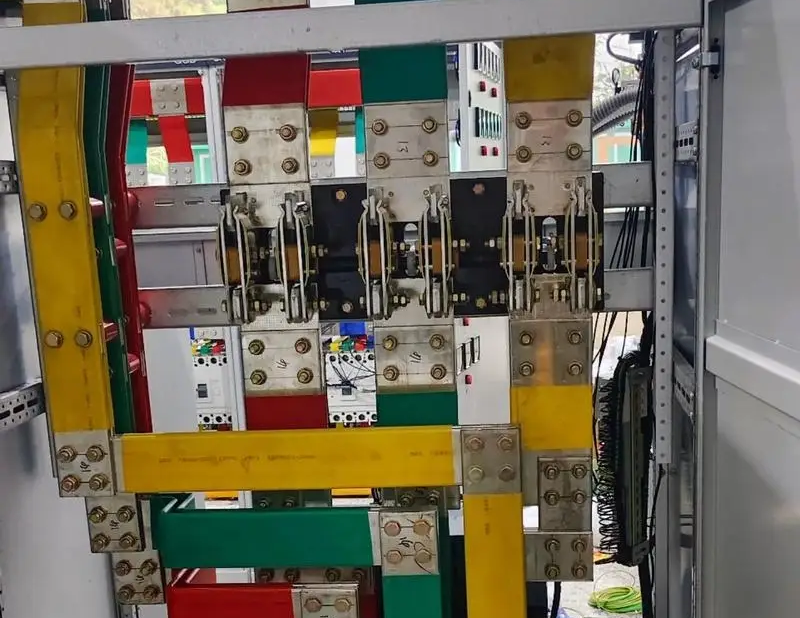
A Current Transformer (CT) cabinet is a specialized electrical enclosure designed to house current transformers and their associated wiring. As part of an electrical distribution system, its main role is to enable the accurate measurement of high electrical currents for metering purposes, particularly in commercial and industrial settings.
Beyond metering, CT cabinets serve two other critical functions:
- Safety: Their primary role includes protecting operators and personnel from potentially fatal electric shocks from high-voltage components.
- Protection: The durable enclosure safeguards the sensitive current transformers inside from environmental factors such as rain, sleet, and the formation of external ice, especially in outdoor applications.
How Does a CT Cabinet Work?
The cabinet itself is an enclosure, but its function relies on the current transformers (CTs) it contains. A CT is an instrument transformer that “steps down” a high primary current to a much lower, standardized secondary current. This allows a standard ammeter to accurately measure currents that would otherwise be far too high for it to handle.
When a building or facility consumes more power than a standard meter can handle (typically over 400 amps), a CT cabinet is installed. The high-current service entrance conductors pass through the CTs within the cabinet. The CTs produce a proportional, smaller current that is then fed to the utility’s electric meter, which is often housed in a separate, smaller CT meter socket.
When is a CT Cabinet Required?
CT cabinets are necessary for electrical services with high amperage, generally those rated at 400 amps or more. While standard meter bases max out around 400 amps, CT cabinets are designed for services ranging from 400 amps up to 3000 amps. The power authority usually supplies and installs its own CTs inside the cabinet and then secures the doors with a padlock or seal to prevent unauthorized access.
Construction and Components
CT cabinets are built for durability and security, with several key features:
- Enclosure Rating: Many are designed for outdoor use and carry a Type 3R rating, indicating protection against falling rain and ice.
- Security: They feature hinged doors and have provisions for padlocks and seals, as required by utility companies to ensure the integrity of the metering equipment.
- Internal Layout: Inside, the cabinet includes mounting provisions for either donut-style or bar-type current transformers. They can be ordered with mounting bases and wire lugs pre-installed to simplify installation.
- Bussed Cabinets: For larger services (400A to 1200A and above), bussed cabinets are available. These come with factory-installed busbars that provide a robust and organized solution for terminating the large phase and neutral conductors.
Installation and Code Requirements
The installation of a CT cabinet is strictly regulated to ensure safety and proper function. All installations must comply with local utility company standards and the National Electrical Code (NEC).
Key requirements often include:
- NEC Compliance: Cabinets must meet the specifications of NEC Article 312, which covers cabinets, cutout boxes, and meter socket enclosures.
- Working Space: Adequate clearance must be maintained around the cabinet as mandated by the NEC. This ensures technicians can work safely and that the cabinet doors can open fully, often requiring a space 48 inches deep.
- Mounting and Grounding: The cabinet, meter socket, and all conduits must be securely mounted to a building wall or other structure. Furthermore, all enclosures must be properly grounded and bonded according to NEC requirements to prevent electrical hazards.
- Utility Approval: The local power utility often dictates the final specifications for the cabinet, its placement, and the metering setup. Contacting the utility before starting work is a critical step.
Types of CT Cabinets
Beyond their basic function, CT cabinets can be classified in several ways, providing options for different applications and environments:
- By Mounting Style: Depending on the installation site and size, they are available in freestanding/pedestal mount, wall-mounted, and pad-mounted designs.
- By NEMA/UL Rating: These ratings certify the enclosure’s ability to protect against environmental conditions. While the previous response mentioned NEMA 3R, a wider range of ratings is available, including:
- NEMA Type 1: For indoor use, offering protection from dust and incidental contact.
- NEMA Type 3R: Suitable for both indoor and outdoor use, providing protection against rain, sleet, and the formation of ice on the enclosure.
- NEMA Type 4 and 4X: These offer a higher level of protection against water, including from hoses. Type 4X adds significant corrosion resistance, making it ideal for harsh industrial or coastal environments.
- By Functional Design: Specialized designs combine multiple functions into one unit:
- Cabinets with PT Options: Some cabinets include a separate compartment or rack options for Potential Transformers (PTs), allowing for the measurement of both current and voltage.
- Transockets: This design integrates the current transformers and the meter socket into a single enclosure, which is a common requirement in certain regions like the American Southwest.
Materials and Construction
The durability and safety of a CT cabinet are directly related to its construction:
- Materials: They are almost always metallic, with common choices including galvanized iron, carbon steel, aluminum, and stainless steel. The use of metal allows the cabinet itself to be integrated into the electrical grounding system.
- Fabrication and Protection: Manufacturing involves techniques like cutting, welding, and bending1. A protective powder coating, typically a blend of epoxy and polyesters, is applied to protect the cabinet from chemicals, extreme weather, and physical scratches7.
- Doors: Cabinet doors are often made from cold-rolled steel sheets and must be able to open at least 120 degrees. They are equipped with strong, corrosion-resistant hinges (e.g., galvanized, stainless steel, bronze) and a handle to ensure a rigid and secure seal when closed1.
Key Associated Components
A complete CT metering setup involves more than just the cabinet and transformers:
- Types of CTs: The transformers inside can be either window-type (also called “doughnut” style), where the primary conductor passes through an opening, or bar-type, which includes an integrated bus bar as the primary conductor. Bar types can simplify wiring for very large conductors.
- Potential Transformers (PTs): Also called Voltage Transformers (VTs), these are often used in conjunction with CTs to step down high system voltages to a safer, lower level for the meter.
- Test Switches: Often required by utility companies, these devices are installed in the meter socket wiring to allow technicians to safely test the meter or bypass it by “shunting” the CTs without interrupting power to the customer.
Common Pitfalls and Regional Differences
While the general purpose of a CT cabinet is universal, specific requirements and common mistakes can vary:
- Varying Amperage Thresholds: The rule of thumb for requiring a CT cabinet is for services over 400 amps, but this is not universal. On the US West Coast, for instance, the Electric Utility Service Equipment Requirements Committee (EUSERC) standards mandate CTs for applications above 200 amps at 480V.
- Installation Errors: Common mistakes to avoid include using incorrectly sized CTs (which can overheat or provide inaccurate readings), failing to properly ground the cabinet, and poor labeling, which complicates future maintenance.